Nigel Warburton Powerful Ideas That Bring Philosophy To Everyone
The British philosopher making complex ideas clearer through books, teaching, interviews, and Philosophy Bites

Introduction
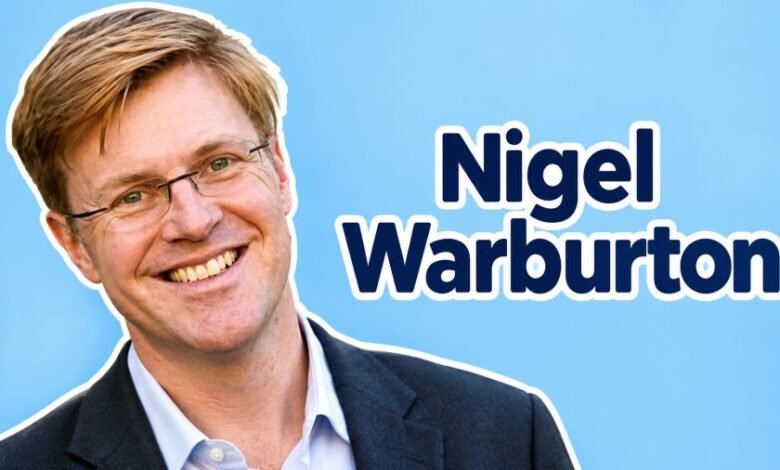
Nigel Warburton is a British philosopher, writer, podcaster, and philosophy populariser whose work has helped make philosophical thinking accessible to a much wider audience. Rather than presenting philosophy as a subject limited to universities, he has consistently explained difficult questions in a clear and approachable style. His books, interviews, teaching, and podcasts have introduced generations of readers and listeners to major ideas about ethics, politics, knowledge, art, freedom, and human life.
His career combines academic experience with public philosophy. He studied philosophy at the University of Bristol and later completed a PhD at Darwin College, University of Cambridge. He subsequently taught at the University of Nottingham and the Open University before becoming a freelance philosopher and writer. His best-known public project, Philosophy Bites, has become one of the most widely listened-to philosophy podcasts, demonstrating how powerful philosophical conversations can become when they are presented in a concise and engaging way.
Quick Bio
| Category | Details |
|---|---|
| Full Name | Nigel Warburton |
| Profession | British philosopher, writer, podcaster |
| Born | 1962, England |
| Nationality | British |
| Education | University of Bristol; Darwin College, University of Cambridge |
| Academic Field | Philosophy |
| Former Academic Roles | University of Nottingham; Open University |
| Best Known For | Philosophy Bites and accessible philosophy books |
| Major Book | A Little History of Philosophy |
| Podcast Co Host | David Edmonds |
| Current Professional Description | Freelance philosopher, writer and podcaster |
| Known Location | Oxford, UK |
Early Life and Education
Nigel Warburton was born in England in 1962. Reliable biographical sources establish the year and country of his birth, while detailed information about his wider family background is not necessary to understand the development of his professional career. His public biography is much more strongly documented through his education, academic work, books, and philosophy projects.
His academic journey began with philosophy at the University of Bristol. He later continued his postgraduate studies at Darwin College, University of Cambridge, where he completed doctoral research in philosophy. This academic foundation became important to his later work because his career developed around explaining philosophical arguments while maintaining attention to serious philosophical scholarship.
Academic Career and Teaching
Warburton began his academic teaching career as a lecturer in philosophy at the University of Nottingham. His work there provided experience in presenting philosophical subjects to university students and engaging with established areas of the discipline.
In 1994, he joined the Department of Philosophy at the Open University. He eventually became a Senior Lecturer, combining academic teaching with writing and research. His time in higher education gave him a strong foundation for the accessible philosophy style that later became central to his public career.
Moving Beyond Traditional Academia
Warburton eventually left his Senior Lecturer position at the Open University in May 2013. This marked an important change in his professional life. Instead of concentrating primarily on a conventional university career, he increasingly worked as a freelance philosopher, writer, interviewer, and podcaster.
This change was not a rejection of philosophy. Instead, it allowed him to reach audiences beyond traditional academic institutions. His later career demonstrates that philosophical education can take place through books, podcasts, public interviews, journalism, and cultural institutions as well as university classrooms.
Philosophy Bites and Public Philosophy
One of the defining achievements of Nigel Warburton’s career is Philosophy Bites, the podcast he established with David Edmonds in 2007. The format is deliberately accessible: leading philosophers discuss important philosophical questions through relatively short interviews rather than lengthy academic lectures.
The podcast has covered subjects ranging across ethics, politics, metaphysics, philosophy of mind, aesthetics, religion, free will, knowledge, and the meaning of life. Its success shows the continuing public interest in philosophical questions when they are explained without unnecessary technical barriers. Current publisher information describes the podcast as having been downloaded more than 48 million times.
Philosophy Bites also became a publishing project. A book based on the podcast appeared in 2010, followed by Philosophy Bites Back and other related collections. These publications extended the podcast’s central idea: important philosophical conversations can be short, focused, intellectually serious, and understandable to general readers.
Books by Nigel Warburton
Writing has remained one of the most important parts of Warburton’s contribution to public philosophy. His books are particularly useful for students and readers who want an introduction to philosophical ideas without beginning with highly specialized academic texts.
Among his best-known works are Philosophy: The Basics, Philosophy: The Classics, Thinking from A to Z, The Art Question, Free Speech: A Very Short Introduction, Philosophy: The Essential Study Guide, and A Little History of Philosophy. His bibliography demonstrates a broad interest in philosophical education, critical thinking, aesthetics, political philosophy, and the history of ideas.
A Little History of Philosophy
A Little History of Philosophy is arguably his most widely recognized book. Published in 2011, it presents the history of Western philosophy through forty concise chapters covering major thinkers and ideas. The book moves from ancient philosophy toward modern thinkers and introduces readers to figures including Socrates, Descartes, and Peter Singer.
The strength of the book is its accessibility. Instead of treating philosophy as an abstract collection of difficult theories, Warburton connects philosophical arguments with the lives, questions, and intellectual challenges of the thinkers who developed them. The result is an introduction designed for curious readers who may have little previous experience with philosophy.
His Approach to Philosophy
A central feature of Warburton’s approach is clarity. He has spent much of his career showing that philosophical ideas can be explained accurately without making them unnecessarily complicated.
His work also encourages active thinking. Philosophy, in his presentation, is not simply about remembering the names of historical thinkers. It involves questioning assumptions, examining arguments, identifying weaknesses in reasoning, and considering different answers to difficult questions.
There is a positive side to this approach because it opens philosophy to people who might otherwise find the subject intimidating. The potential negative side is that introductory explanations can never contain every detail of a complex philosophical debate. Nevertheless, accessibility has remained one of the defining strengths of his public work.
Work in Free Speech and Aesthetics
Warburton has written about several specialized areas of philosophy as well as general introductions. His book Free Speech: A Very Short Introduction examines philosophical and political questions surrounding freedom of expression, while The Art Question explores philosophical issues connected with art and aesthetics. His publications therefore extend beyond introductory history and into debates that remain relevant to contemporary society.
His interests have also included photography and architecture. He wrote Erno Goldfinger: The Life of an Architect, demonstrating that his intellectual interests are not restricted to traditional philosophical texts. His broader body of work reflects a continuing interest in how ideas shape culture, artistic judgment, public life, and individual reasoning.
Philosophy Editor and Interviewer
Warburton has also built a substantial career through interviewing other thinkers. He has served as philosophy editor at Five Books since 2013, where he interviews philosophers and recommends books covering subjects such as critical thinking, Western philosophy, ethics, and contemporary philosophical writing.
His recommendations reveal a strong interest in major philosophical works. Among the texts he has discussed are Plato’s Republic, Descartes’ Meditations on First Philosophy, David Hume’s An Enquiry Concerning Human Understanding, John Stuart Mill’s On Liberty, and Ludwig Wittgenstein’s Philosophical Investigations.
Television, Cultural Education, and Public Engagement
Warburton’s public philosophy work has not been limited to books and podcasts. His professional biography also connects him with teaching and philosophy-related activities at cultural institutions, including Tate Modern.
He contributed to the BBC’s History of Ideas project, writing scripts for a 48-part animated series. This work further reflects his ability to translate philosophical ideas into formats suitable for broad audiences.
Nigel Warburton Career Timeline
1962
Nigel Warburton was born in England.
University Years
He studied philosophy at the University of Bristol and later pursued doctoral research at Darwin College, University of Cambridge.
Early Academic Career
He became a lecturer in philosophy at the University of Nottingham.
1994
He joined the Open University Department of Philosophy.
2007
He and David Edmonds established Philosophy Bites, beginning a major new chapter in his public philosophy career.
2009
His book Free Speech: A Very Short Introduction was published as part of the Very Short Introductions series.
2010
Philosophy Bites appeared as a book based on the successful podcast.
2011
A Little History of Philosophy was published, becoming one of his best-known works.
2013
He left his Senior Lecturer position at the Open University and increasingly focused on freelance philosophy, writing, interviewing, and podcasting.
2013 Onward
He continued his work as philosophy editor and interviewer at Five Books while developing further public philosophy projects.
Present
He continues to be described publicly as a freelance philosopher, writer, and podcaster, with Philosophy Bites remaining a major part of his professional legacy.
Personal Life and Professional Identity
Publicly available professional biographies provide a clear picture of Warburton’s intellectual career but do not establish extensive private-life details. What is well documented is his professional identity as a British philosopher, writer, interviewer, and podcaster.
Current biographical material identifies him as living in Oxford, UK. His public work remains focused primarily on philosophy, books, interviews, podcasts, and making intellectual discussion accessible to wider audiences.
Why Nigel Warburton Matters
The importance of Nigel Warburton lies partly in his ability to bridge the gap between academic philosophy and everyday readers. Academic philosophy can sometimes appear difficult because of its specialized vocabulary and detailed arguments. Warburton’s writing and broadcasting demonstrate another possibility: serious ideas can be communicated clearly without abandoning intellectual substance.
His influence is especially visible through Philosophy Bites and his introductory books. By combining scholarship with accessible communication, he has helped encourage people to approach philosophy as something they can actively explore rather than simply study for an examination.
Conclusion
Nigel Warburton has built a distinctive career as a British philosopher who brings philosophical thinking beyond the traditional university environment. From his education at Bristol and Cambridge to academic posts at Nottingham and the Open University, his career developed through teaching, writing, research, and public engagement.
His later work has made him particularly recognizable as a philosophy communicator. Through Philosophy Bites, A Little History of Philosophy, his other books, interviews, and cultural projects, he has encouraged readers and listeners to question assumptions and think more carefully. His career shows that philosophy can remain rigorous while also being approachable, relevant, and useful to ordinary people.
Frequently Asked Questions
1. Who is Nigel Warburton?
Nigel Warburton is a British philosopher, writer, podcaster, and public philosophy communicator known especially for Philosophy Bites and accessible philosophy books.
2. When was Nigel Warburton born?
Nigel Warburton was born in 1962 in England.
3. Where did Nigel Warburton study?
He studied philosophy at the University of Bristol and completed doctoral study at Darwin College, University of Cambridge.
4. Where does Nigel Warburton live?
Current biographical information identifies Oxford, UK, as his place of residence.
5. What is Nigel Warburton best known for?
He is best known for Philosophy Bites, his introductory philosophy books, and his work making philosophical ideas accessible to general audiences.
6. Is Nigel Warburton an academic philosopher?
He has an academic background and previously held teaching positions at the University of Nottingham and the Open University, but he is now described professionally as a freelance philosopher, writer, and podcaster.
7. When did Philosophy Bites begin?
Philosophy Bites was established by Nigel Warburton and David Edmonds in 2007.
8. What is A Little History of Philosophy about?
A Little History of Philosophy introduces major Western philosophers and their ideas through forty concise and accessible chapters.